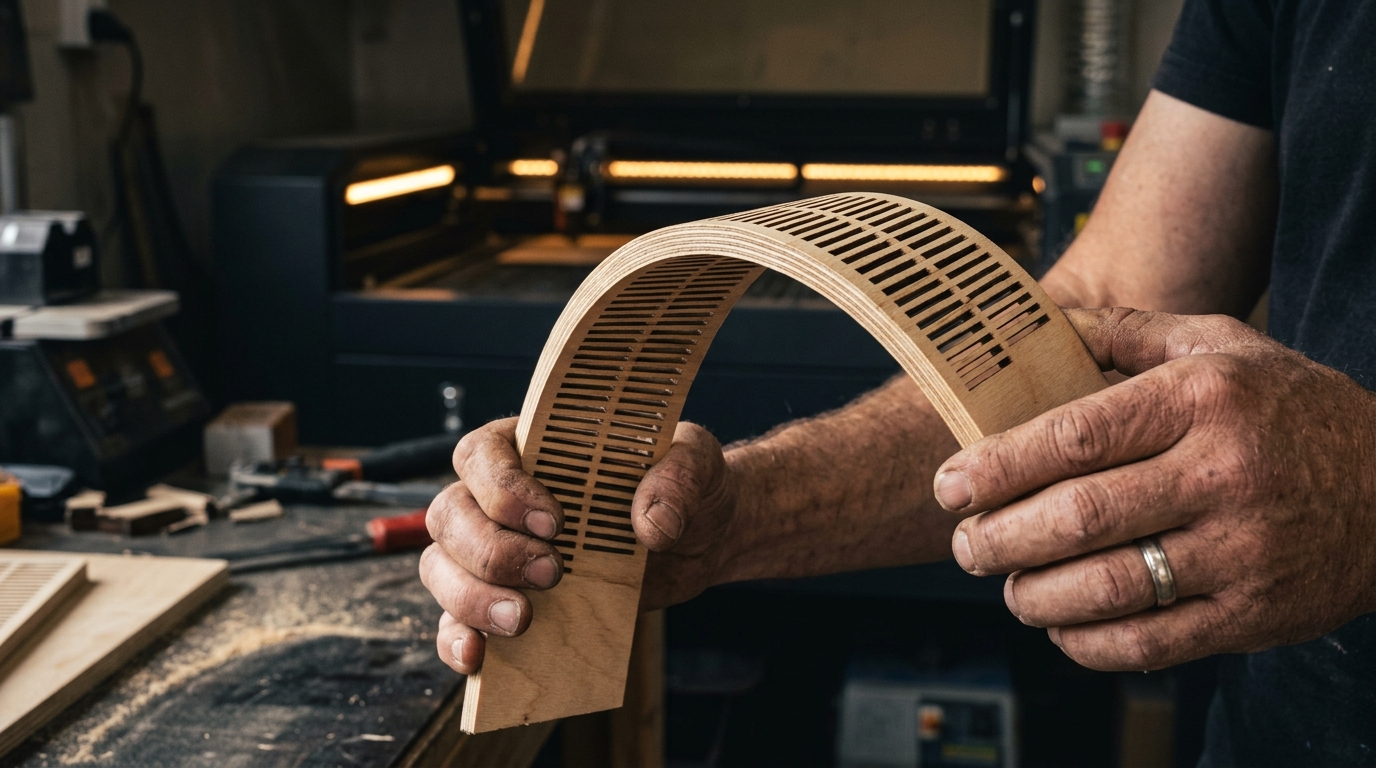
Why Wood Cracks: The Mechanics of the Laser Living Hinge
Wood is naturally rigid along its longitudinal grain fibers. When you attempt to bend a solid piece of 3mm Baltic birch plywood, the outer surface is subjected to high tensile stress (stretching) while the inner surface experiences compressive stress. Because dry wood fibers possess high tensile strength but low elasticity, the outer veneer snaps almost immediately.
A laser-cut living hinge solves this fundamental material limitation by converting tensile bending stress into torsional shear stress. Instead of bending the wood fibers directly, the alternating lattice slits allow small rectangular connecting bridges to twist slightly along their axes.
Generate Your Custom Flexible Hinge Pattern
Input your material thickness and desired bend dimensions to get an optimized parametric lattice pattern instantly.
Open Living Hinge Generator →The 5 Engineering Rules of Laser Living Hinges
Rule 1: The Minimum Bend Radius Formula
As a proven workshop rule of thumb, the minimum bend radius you can reliably achieve without cracking is approximately 3 to 5 times material thickness:
For standard 3.0mm Baltic birch plywood, aim for a minimum radius of 10.5mm to 15mm. If your design requires a tight 6mm pencil radius, switch to 1.5mm or 2.0mm aircraft birch.
Rule 2: Calculate Required Arc Width Exactly
To wrap around a 90-degree corner or 180-degree cylinder, calculate the required flat hinge width (arc length) before cutting:
For a 90-degree curved corner with an inner radius of 20mm and 3mm wood (effective radius = 21.5mm):
Hinge Width = 2 × 3.14159 × 21.5 × (90 / 360) = 33.77mm.
Rule 3: Slit Spacing vs. Hinge Stiffness
- Too Tight (< 2.0mm column spacing): The hinge becomes so fragile that small handling impacts will tear the wooden bridges.
- Too Loose (> 5.0mm column spacing): The wood requires excessive force to bend, creating visible flat facets instead of a smooth organic curve.
- Sweet Spot for 3mm Birch: Cut Length = 18mm – 22mm, Column Spacing = 3.0mm – 3.5mm, Line Gap = 2.0mm – 2.5mm.
Rule 4: Surface Conditioning & Post-Processing
Applying mineral oil, Danish oil, or bees-wax to the hinge after laser cutting softens the wood fibers and prevents them from drying out over time, ensuring your hinge continues flexing smoothly for thousands of cycles.
Organize Your Workshop Operations with 0Machine Pro
From CAD generation to inventory tracking, client invoicing, and production orders, 0Machine Pro is the all-in-one operating system for modern laser and CNC workshops.
Get Started with 0Machine Pro →