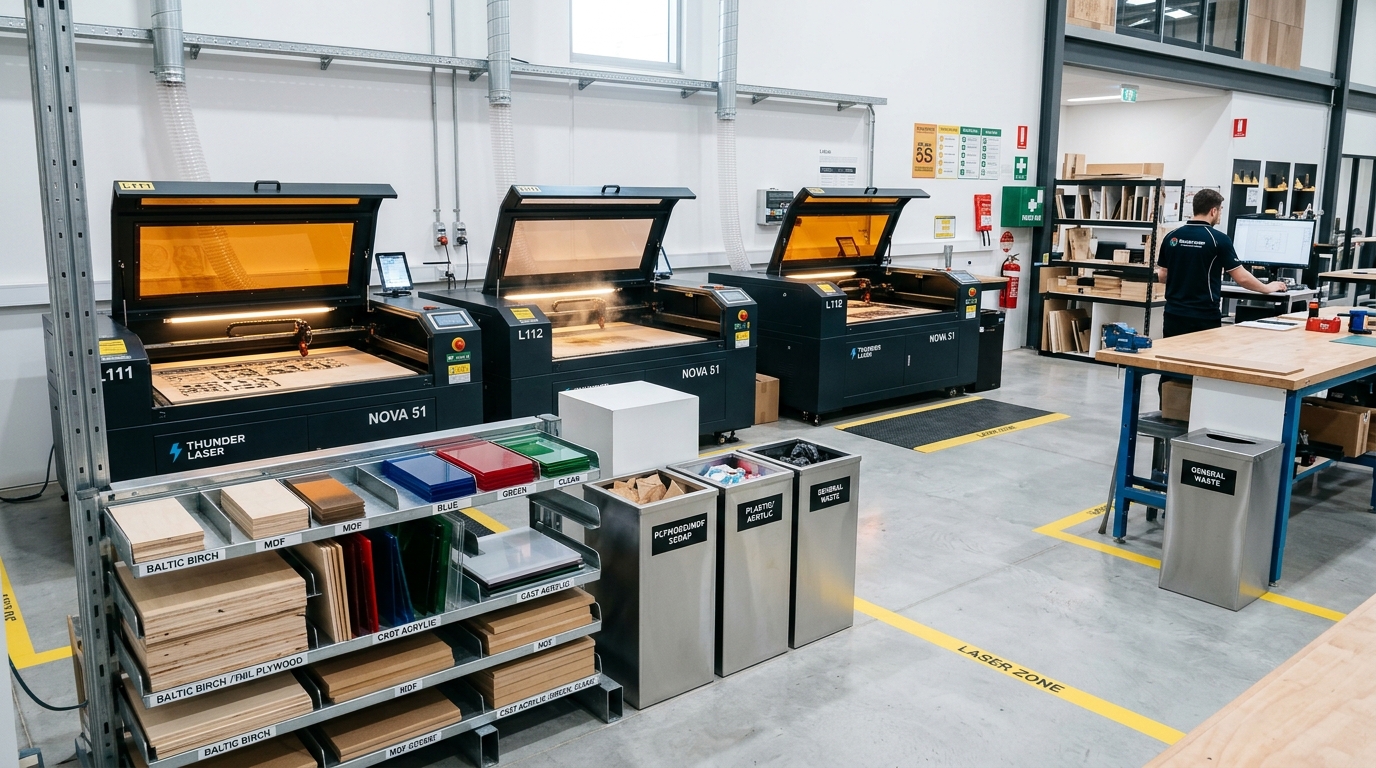
The Scrap Bin: Where Workshop Profit Goes to Die
Walk into almost any laser cutting business or digital fabrication lab, and you will see the exact same sight: overflowing storage bins filled with odd-shaped remnants of expensive Baltic birch plywood, half-used sheets of cast acrylic, and scraps of MDF. Most shop owners tell themselves: "I'll use those pieces for small keychains later."
In reality, 85% of those remnants sit in the rack gathering dust until they warp, get scratched, and end up in the municipal dumpster. If you spend $3,000 a month on raw materials and waste 30%, you are throwing $10,800 in raw cash into the trash every single year.
Estimate Sheet Scrap Before You Cut
Input your sheet and part dimensions into our free nesting estimator to determine your exact material yield and avoid purchasing excess stock.
Open Sheet Nesting Estimator →5 Strategies to Cut Material Waste Immediately
1. Implement Common-Line Cutting (Shared Edges)
When cutting dozens of rectangular badges, gift tags, or box panels, do not space parts 2mm apart. Use common line cutting in LightBurn or CAD to share the border line. One laser cut separates two parts simultaneously:
- Reduces laser machine run time by 25% to 40%.
- Eliminates 2mm to 3mm of scrap between every column and row.
- Reduces CO2 laser tube hours and electricity consumption.
2. Nest Smaller Parts Inside Interior Hollow Cutouts
If you are cutting large picture frames, clock rims, or decorative wall monograms, the center void of the shape is pure wasted material if left blank. Program your nesting workflow to pack small keychains, earrings, and test chips inside these internal cutouts.
3. Standardize Sheet Purchases to Match Machine Honeycomb Beds
Buying 4×8 ft (1220×2440mm) commercial plywood sheets and cutting them down on a table saw with inaccurate measurements wastes 50mm strips on every sheet. Work with your supplier to break sheets down to exact multiples of your laser bed (e.g. 600×400mm or 1200×600mm) with zero off-cut loss.
4. Adopt the "Remnant First" Production Rule
Establish a strict shop rule: before an operator is permitted to pull a brand-new pristine sheet from the main inventory rack, they must check the off-cut remnant rack for pieces that fit the job footprint.
Log & Reuse Off-Cut Remnants with 0Machine Pro
Never lose track of partial sheets again. 0Machine Pro lets you catalog remnant sheet sizes, sync them with customer orders, and pack shapes directly onto irregular scrap stock.
Explore Material Management in Pro →