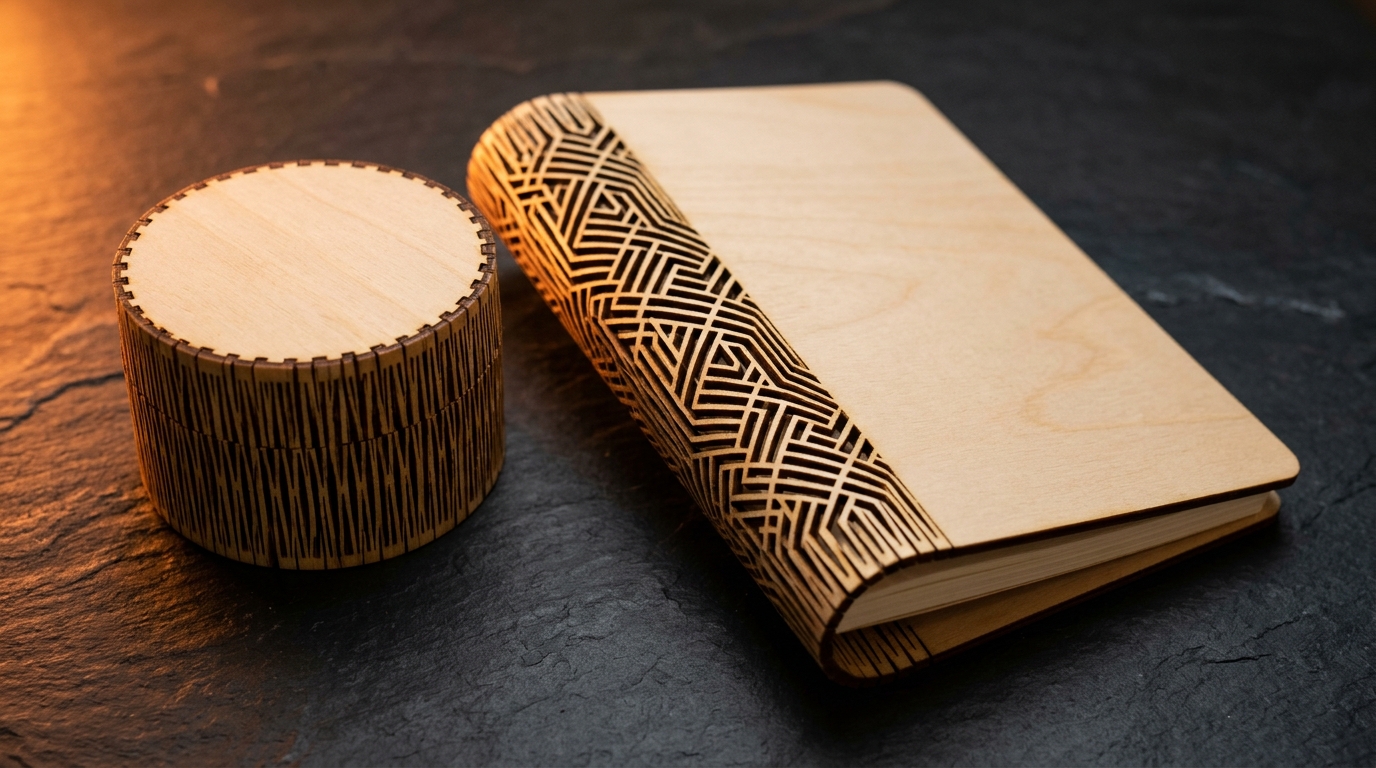
Turning Rigid Wood Into Flexible Curves
One of the most magical capabilities of a CNC laser cutter is the ability to transform rigid, flat sheet stock into fluid, organic curved shapes. Using a technique known as a living hinge (or lattice hinge), you can create wooden book covers with flexible spines, rounded jewelry boxes, curved cylindrical lamps, and ergonomic laptop stands—all from a single flat sheet of plywood.
However, drawing hundreds of alternating staggered cut lines manually in CAD is tedious and error-prone. If your slits are spaced too close together, the wood snaps under tension. If they are spaced too far apart, the hinge is too stiff to bend without splintering.
Generate Parametric Living Hinges in Seconds
Set your hinge width, height, cut length, and column spacing. Download LightBurn-ready SVG and AutoCAD DXF files ready for laser cutting.
Launch Free Living Hinge Generator →How Living Hinge Geometry Works
A living hinge functions by dividing the bending force across dozens of microscopic torsion springs. When you bend the hinge, the narrow connecting webs of wood between the staggered slits twist slightly in torsion rather than bending in pure tension.
Key parameters in the 0Machine Living Hinge Generator:
- Hinge Width (W): The arc length of your bend (e.g. for a 90-degree bend around a 20mm radius, Arc Length = (π × 20) / 2 ≈ 31.4mm).
- Hinge Height (H): The total vertical height of your box or journal spine.
- Slit Cut Length: The length of individual cut segments (typically 15mm to 25mm).
- Cut Column Spacing: The horizontal pitch between rows of slits (typically 3.0mm to 4.5mm for 3mm wood).
- Line Gap: The uncut web connecting the segments (typically 2.0mm to 3.0mm).
Golden Rule: Wood Grain Alignment
The single most important rule when cutting living hinges in plywood or hardwood veneer is grain direction:
Access 5,000+ Production-Ready Laser Design Packs
Don't reinvent the wheel. 0Machine Pro includes our commercial vector design vault with pre-tested living hinge boxes, book covers, lamps, and organizers complete with commercial resale licenses.
Explore Commercial Design Vault in Pro →