Why Raw Material Is Your Biggest Workshop Expense
In custom manufacturing, raw sheet stock represents between 35% and 55% of your total cost of goods sold (COGS). When Baltic birch plywood prices surge, or cast acrylic costs $45 a sheet, every percentage point of wasted material comes directly out of your net profit.
Most workshops estimate sheet requirements by taking the square area of the part, dividing it into the square area of the sheet, and calling it a day. In the real world, this theoretical math fails completely: rectangular sheet boundaries, kerf spacing gaps, and clamping margins mean that 25% to 40% of the sheet is frequently lost to unusable off-cut scrap.
Calculate Exact Parts Per Sheet & Material Profit
Input sheet size, part dimensions, target quantity, and kerf spacing to see your exact sheet yield percentage, required sheet count, and gross profit instantly.
Launch Sheet Nesting Calculator →The Mathematics of Sheet Yield and Scrap
To accurately calculate material efficiency, measure both Geometric Yield and Economic Scrap:
Example Comparison:
Suppose you need to produce 100 acrylic badges (80×50mm) on standard 600×400mm sheets:
- Standard Orientation: (600 / 82) = 7 cols; (400 / 52) = 7 rows = 49 parts per sheet (Requires 3 sheets, 18% scrap).
- Rotated 90° Orientation: (600 / 52) = 11 cols; (400 / 82) = 4 rows = 44 parts per sheet.
- Mixed Hybrid Packing: 44 horizontal parts + 14 vertical parts nested into the remnant edge = 58 parts per sheet (Requires only 2 sheets, cutting material costs by 33%).
Cut 35% More Waste with True-Shape Polygon Nesting
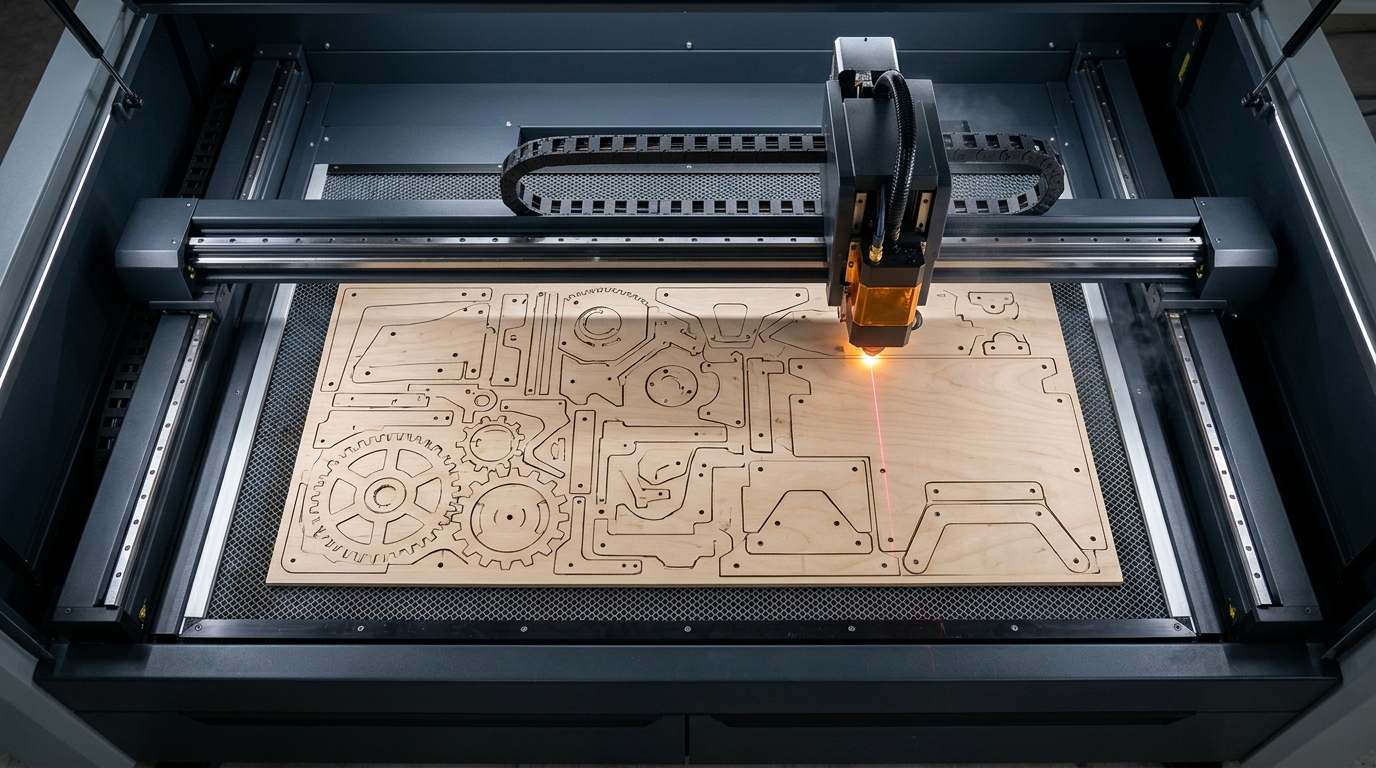
Cutting non-rectangular, organic, or concave shapes? 0Machine Pro utilizes industrial ClipperLib polygon packing to nest small parts inside interior voids and off-cut remnants, exporting cut-ready DXF and SVG files directly to LightBurn.
Launch True-Shape Nesting Studio in Pro →